Introduction
A single temperature deviation during pharmaceutical shipping can render life-saving medications ineffective, triggering product recalls, financial losses, and patient harm. The pharmaceutical industry loses approximately $35 billion annually due to temperature-controlled logistics failures, with up to 50% of vaccines wasted globally each year from cold chain breakdowns. In 2025, the FDA issued a Class II recall for GSK's Benlysta, citing "potential temperature excursions due to transit delays." Regulatory enforcement in this space is only getting stricter.
This guide walks through the critical elements of refrigerated pharmaceutical transport: temperature standards, regulatory requirements, common failure points, and the practices that keep product integrity intact from manufacturer to final delivery. Whether you're managing hospital procurement, running a clinical trial, or developing a new vaccine, the stakes are the same.
Key Takeaways
- Refrigerated pharmaceutical transport keeps drugs within strict temperature ranges (typically 2°C–8°C) to preserve efficacy and patient safety
- WHO GDP, FDA CFR, and IATA set mandatory cold chain standards — especially for international and air freight
- Temperature excursions affect roughly 12% of shipments; supply chain disruptions and inconsistent regulations across markets compound the risk
- Validated packaging, continuous monitoring, real-time visibility, and trained personnel are the pillars of a reliable cold chain
- An FDA-registered logistics partner with cross-border expertise is essential for protecting product integrity
What Is Refrigerated Pharmaceutical Transport and Why It Matters
Refrigerated pharmaceutical transport is the movement of temperature-sensitive drug products within a controlled temperature band—typically 2°C–8°C—from point of manufacture through storage, transit, and final delivery. This sits between ambient (room temperature) and cryogenic transport, which operates at ultra-low temperatures below -150°C.
Biopharmaceuticals, vaccines, and biological drugs have complex molecular structures that degrade under temperature fluctuations. The WHO estimates that up to 50% of vaccines are wasted globally every year, largely due to inadequate temperature control and logistics infrastructure. Even brief excursions above 8°C can cause irreversible protein denaturation (structural breakdown), while temperatures below 2°C may cause freezing damage that destroys product efficacy.
Beyond $35 billion in annual industry losses, temperature failures trigger regulatory action, product destruction, and direct patient safety risks. Biologics administered after temperature compromise may deliver reduced efficacy—or worse, harmful degradation products.
Product categories that require refrigerated transport include:
- Vaccines (including adjuvanted vaccines like Shingrix and Arexvy)
- Monoclonal antibodies
- Insulin and diabetes medications
- Select biologics and biosimilars
- Certain oncology drugs
- Cell and gene therapy products
- Clinical trial materials
For pharmaceutical manufacturers, clinical trial sponsors, specialty distributors, and vaccine developers, an unbroken cold chain is not a logistical preference—it's a clinical requirement. The sections below break down exactly how to meet it.
Temperature Categories in Pharmaceutical Cold Chain
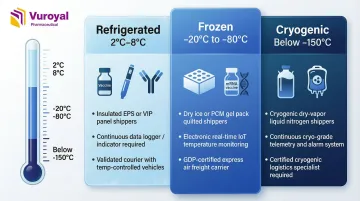
Understanding which temperature category applies to a specific product is the foundation of compliant transport planning. The pharmaceutical cold chain operates across three main temperature tiers, each with distinct packaging, monitoring, and regulatory requirements.
Refrigerated (2°C–8°C)
The refrigerated tier is the most commonly used range, covering products like vaccines, insulin, monoclonal antibodies, and biological reference drugs. This is VuRoyal's primary focus for specialty drug and vaccine adjuvant distribution, including QS-21 and Matrix-M™ products used in globally approved vaccines.
Key handling considerations:
- Even brief excursions above 8°C can cause irreversible protein denaturation
- Excursions below 2°C may cause freezing damage—a Sensitech study found that 80% of direct-to-patient shipments failed to maintain proper temperatures because pharmacists improperly placed frozen gel packs in direct contact with products, causing thermal shock and temperatures below -5°C
- Product labels and manufacturer specifications define the precise acceptable range
- Shippers must validate packaging performance for worst-case ambient conditions (summer heat or winter freeze in different regions)
Frozen (-20°C to -80°C)
Frozen storage is required for certain mRNA-based vaccines, plasma-derived products, and clinical trial materials. Pfizer-BioNTech's COVID-19 vaccine requires ultra-low freezer storage between -90°C to -60°C, while Moderna's requires -50°C to -15°C. However, both vaccines utilize the 2°C–8°C refrigerated tier for last-mile distribution after thawing.
Frozen shipments carry additional logistics burdens:
- Dry ice and validated insulated shippers for this range
- Additional documentation burden around dry ice use in air freight
- IATA regulations strictly govern dry ice quantities and handling
- Temperature monitoring must continue throughout the frozen storage period
Cryogenic (Below -150°C)
Cryogenic requirements apply to advanced therapies including cell and gene therapies and certain viral vectors, stored using liquid nitrogen. The Advanced Therapy Medicinal Products (ATMP) market is projected to reach $20 billion at a 26% CAGR between 2020 and 2026, making it the fastest-expanding segment in the cold chain.
That growth comes with significant operational constraints:
- Requires specialized liquid nitrogen shippers and handling protocols
- Extremely limited carrier options and airport facilities
- Highest cost per shipment
- Most stringent documentation and training requirements
The temperature category you assign to a product dictates packaging choices, carrier eligibility, monitoring technology, and the regulatory pathway — which is why this classification comes first in any cold chain planning process.
Regulatory Frameworks Governing Pharmaceutical Cold Chain Transport
Refrigerated pharmaceutical transport operates within a complex, overlapping set of international and national regulatory frameworks. Non-compliance risks product rejection, financial penalties, and patient harm. Regulations vary by country, transport mode, and product type, requiring specialized expertise to navigate successfully.
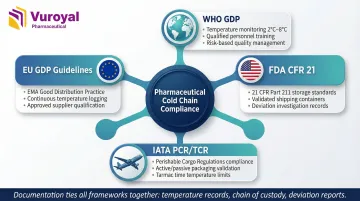
Good Distribution Practices (WHO GDP)
WHO Good Distribution Practices (GDP) provide the global baseline standard governing how pharmaceutical products must be stored, handled, and transported. WHO Technical Report Series No. 961, Annex 9 sets requirements for time- and temperature-sensitive pharmaceutical products (TTSPPs).
Key requirements:
- Temperature-controlled vehicles and storage must be equipped with calibrated continuous temperature monitoring systems with sensors accurate to ±0.5°C
- Annual calibration of monitoring equipment is mandatory
- Temperature excursions are strictly defined as events where a product is exposed to temperatures outside the manufacturer-specified range based on stability data
- Risk assessment, personnel training, and comprehensive documentation are required
Many national regulators—including the EU and China's NMPA—have adopted GDP-aligned frameworks, making WHO GDP the foundation for global pharmaceutical distribution.
U.S. FDA and Code of Federal Regulations (CFR)
Building on WHO GDP's global baseline, the U.S. FDA applies its own layer of requirements through the CFR, including current Good Manufacturing Practice (cGMP) rules that extend to distribution. 21 CFR 211.142 (Warehousing procedures) requires written procedures for storage under appropriate temperature conditions to protect identity, strength, quality, and purity.
Compliance essentials:
- Distribution is regulated as an extension of manufacturing under 21 CFR Parts 210 and 211
- Wholesale distributors must maintain FDA registration under the Drug Supply Chain Security Act (DSCSA)
- Written procedures for temperature control during warehousing and distribution are mandatory
- Temperature monitoring records must be maintained and available for regulatory audit
VuRoyal holds FDA registration as a pharmaceutical wholesaler, covering the cold chain distribution of reference listed drugs and vaccine adjuvants under these CFR requirements.
IATA Regulations for Air Freight
The International Air Transport Association (IATA) sets mandatory requirements for all pharmaceutical and healthcare temperature-controlled shipments by air. IATA's Perishable Cargo Regulations (PCR) and Temperature Control Regulations (TCR) are the governing standards.
Mandatory requirements for air freight:
- Validated packaging qualification for the specific route and duration
- "Time and Temperature Sensitive" label must be affixed to all shipments, indicating the external transportation temperature range
- Acceptance Checklist ensures airlines and ground-handling agents execute minimum checks before transport
- Proper documentation including shipper's declaration and handling instructions
- Time-temperature indicators for shipment monitoring
- Specific labeling and handling instructions for dry ice shipments
Since July 2012, IATA has strictly enforced these requirements to combat tarmac temperature spikes and handling errors that compromise pharmaceutical integrity.
EU GDP Guidelines and International Variation
EU GDP Guidelines (2013/C 343/01) enforce strict cross-border rigor throughout Europe. The supplying wholesale distributor is responsible for ensuring temperature conditions are maintained within acceptable limits during transport.
EU-specific requirements:
- Temperature monitoring equipment must be maintained and calibrated at regular intervals
- Temperature mapping under representative conditions is mandatory for temperature-controlled vehicles
- Risk-based route profiling for all distribution pathways
- Strict qualification of suppliers and contracted premises
International shipments—such as US-to-China corridors—require navigating multiple overlapping regulatory regimes simultaneously. Customs declarations must align with both the exporting and importing country's requirements. China's Good Supply Practice (GSP) Article 105 mandates real-time monitoring and recording of temperature data during transport, adding another compliance layer.
Across all these frameworks, documentation ties the cold chain together: temperature records, chain of custody logs, certificates of conformance, and deviation reports must be maintained and available for regulatory audit at every stage.
Common Challenges in Refrigerated Pharmaceutical Transport
Temperature Excursions: The Primary Operational Risk
Temperature excursions are the leading cause of cold chain failure. Industry analyses indicate that 12% of all pharmaceutical shipments experience at least one temperature excursion. These deviations can occur at any handoff—loading docks, airport tarmacs, customs holds, or last-mile delivery.
Even short-duration deviations may trigger a full quality investigation and potential product destruction. The 2025 FDA Class II recall of GSK's Benlysta explicitly cited "potential temperature excursions due to transit delays," demonstrating that regulatory bodies are actively enforcing cold chain compliance.
Root causes of excursions:
- Human error during packaging (improper gel pack placement, inadequate pre-cooling)
- Equipment failure (refrigeration unit malfunction, power loss)
- Process gaps (extended tarmac delays, customs holds without temperature control)
- Inadequate packaging validation for seasonal extremes
Supply Chain Disruption Risks
Temperature excursions don't happen in isolation. Port delays, flight cancellations, and customs holds compound the risk for products with limited stability windows. The COVID-19 pandemic made this clear: grounded passenger aircraft wiped out a significant share of global air cargo capacity almost overnight, leaving cold chain shipments stranded without contingency options.
High-risk scenarios:
- Clinical trial materials with narrow delivery windows
- Specialty biologics with limited room-temperature stability
- Vaccine campaigns requiring coordinated global distribution
- Cross-border shipments subject to customs inspection delays
Regulatory Complexity for Cross-Border Shipments
Supply chain disruptions are difficult enough to manage domestically. Cross-border pharmaceutical distribution introduces a separate layer of regulatory complexity that can stall shipments entirely.
Different countries maintain different cold chain standards, documentation requirements, and inspection protocols. This makes international corridors like US-to-China routes far more complex to navigate than domestic transport.
Compliance challenges:
- Overlapping requirements from FDA, NMPA, EMA, and IATA
- Varying definitions of temperature excursions and acceptable ranges
- Different documentation formats and language requirements
- Customs brokers who lack pharmaceutical expertise
- Import licensing and registration requirements that vary by product category
Partnering with a distributor that holds specialized export and import qualifications for pharmaceutical products — including customs declaration registration and hands-on regulatory support for imported drug approval — removes much of this burden before it becomes a shipment delay.
Best Practices for Refrigerated Pharmaceutical Transport
Validate Packaging Before Shipping
Use International Safe Transit Association (ISTA) or ASTM-certified thermal packaging that has been validated for the specific route's temperature profile, duration, and seasonal extremes. Not all packaging performs equally in summer versus winter conditions.
Validation essentials:
- ISTA 7E provides testing standards for thermal transport packaging used in parcel delivery systems, with heat and cold profiles developed from real-world transport data
- ASTM D3103 evaluates thermal insulation performance of distribution packages exposed to variable ambient temperature conditions
- Validate packaging for worst-case scenarios (peak summer heat, winter freeze, extended customs delays)
- Test with the actual product configuration, including phase-change materials and gel packs
- Document validation results and maintain records for regulatory audit
Deploy Continuous Temperature Monitoring with Dataloggers
Calibrated electronic dataloggers record temperature at defined intervals throughout the shipment. On arrival, the data provides a compliant, audit-ready record confirming whether the product remained within specification—required under GDP and many country-specific regulations.
Monitoring best practices:
- Use dataloggers with ±0.5°C accuracy (WHO GDP requirement)
- Set recording intervals based on product sensitivity and shipment duration (typically 5-15 minutes)
- Calibrate devices annually with traceable standards
- Position sensors in the warmest location within the package
- Maintain calibration certificates and monitoring records for regulatory inspection
Leverage Real-Time Visibility Technology
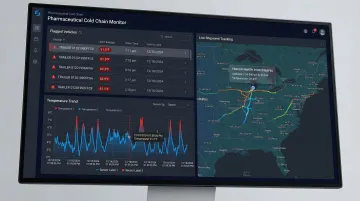
Dataloggers confirm what happened after delivery. Real-time monitoring lets you act before product is lost. GPS-enabled trackers and cloud-based platforms allow shippers to detect temperature excursions and logistical delays in transit, enabling intervention while options still exist.
Logistics vendor Controlant reports up to a 95% reduction in product waste for customers through real-time telemetry and "smart alerting" to intervene before a temperature breach occurs. This represents a dramatic improvement over passive dataloggers that only reveal problems after delivery.
Real-time monitoring advantages:
- Instant notification of temperature deviations
- Proactive intervention during customs delays or tarmac layovers
- GPS location tracking for shipment visibility
- Predictive analytics to identify high-risk scenarios
- Integration with quality management systems for automated deviation reporting
Document Every Step of the Cold Chain
Thorough documentation is both a regulatory requirement and a risk management tool. GDP mandates comprehensive records throughout the distribution chain—from the moment a shipment is packed to final delivery confirmation.
Required documentation:
- Pre-shipment qualification records (packaging validation, equipment calibration, certificates of analysis)
- Temperature logs (continuous monitoring data from departure to delivery)
- Chain of custody forms (documenting every handler and transfer point)
- Post-delivery temperature reports (demonstrating compliance throughout journey)
- Deviation reports (for any excursions or handling exceptions)
- Standard operating procedures (SOPs) for packaging, handling, and monitoring
Train All Personnel Handling Cold Chain Shipments
Human error is a leading cause of temperature excursions. GDP mandates documented training programs, and all handlers—from warehouse staff to customs brokers—should understand product temperature requirements and proper handling procedures.
Training essentials:
- Correct packaging methods: gel pack placement, insulation layering, and container sealing
- Operation of refrigeration units, monitoring devices, and temperature-mapping equipment
- Excursion response: escalation procedures, product quarantine, and deviation reporting
- Chain-of-custody documentation and temperature log completion
- Seasonal adjustments for summer heat exposure and winter freeze risk
A Sensitech study found that 80% of pharmacy shipment failures traced back to improper frozen gel pack placement—a packaging step that standardized training directly prevents.
Choosing the Right Cold Chain Logistics Partner
Selecting a refrigerated pharmaceutical logistics partner requires careful evaluation across multiple dimensions. The wrong partner introduces risk at every handoff, while the right partner becomes an extension of your quality management system.
Key Evaluation Criteria
Start with regulatory credentials. Verify that any prospective partner holds FDA registration, applicable wholesale distribution licenses, GDP-compliant quality systems, and customs declaration registration for international shipments. VuRoyal holds all four — FDA registration, Massachusetts wholesale pharmaceutical licensing, drug business quality management certification, and customs declaration unit registration.
Beyond credentials, evaluate three capability areas:
Regulatory credentials and licenses:
- FDA registration and applicable wholesale distribution licenses
- GDP-compliant quality management systems with third-party verification
- Drug business licenses and quality management standard certifications
- Customs declaration registration for international shipments
Product category expertise:
- Demonstrated experience with vaccines, biologics, and specialty drugs
- Understanding of product-specific temperature requirements
- Validated packaging solutions for the specific product category
- Track record with clinical trial materials and reference listed drugs
International capabilities:
- Specialized export/import qualifications for cross-border shipments
- Experience navigating US-to-China regulatory corridors
- Relationships with customs authorities and regulatory agencies
- Compliance expertise across FDA, NMPA, and IATA frameworks
The Value of an End-to-End Partner
An end-to-end partner manages not just transportation but also customs clearance, regulatory filing support, and cold chain documentation—reducing the number of handoffs (each a risk point) and providing a single accountable party.
Consolidating under one partner delivers:
- Fewer custody transfers, which directly reduces excursion risk
- Single point of accountability for temperature integrity
- Integrated documentation across the entire supply chain
- Streamlined communication during disruptions
- Lower total cost of ownership through reduced coordination overhead

Specialty Product Considerations
End-to-end capability becomes especially critical for specialty products. For vaccine adjuvants like QS-21 and Matrix-M™, reference listed drugs, and clinical trial materials, working with a distributor that has deep product knowledge and a validated global supply chain is a quality and compliance requirement — not a convenience.
Why it matters in practice:
- Each gram of QS-21 enables 20,000–40,000 human doses — product loss has cascading impact
- Reference listed drugs require chain of custody documentation for regulatory submissions
- Clinical trial materials have narrow delivery windows and strict protocol requirements
- Vaccine adjuvants require specialized handling knowledge and regulatory expertise
VuRoyal's role as the exclusive US-China partner of Desert King International reflects this depth — providing end-to-end cold chain management for QS-21 and related adjuvants from GMP-certified manufacturing through final delivery, with free regulatory guidance for imported drug approval registration.
A useful framework here is Total Cost of Ownership (TCO). Beyond packaging and monitoring fees, TCO accounts for the indirect costs that rarely appear on an invoice: product losses, regulatory delays, brand risk, and patient safety exposure. Cutting corners on one part of the cold chain without accounting for these downstream costs is how a decision that looks cheap on paper turns into ruined product batches and significant downstream liability.
Frequently Asked Questions
What is pharmaceutical transportation?
Pharmaceutical transportation refers to the movement of drugs, vaccines, biologics, and medical products across local, national, and international routes, with strict controls over temperature, handling, and documentation to ensure products arrive safe, effective, and regulatory-compliant.
What is temperature controlled transport?
Temperature-controlled transport uses validated insulated packaging, refrigeration systems, and continuous monitoring to move goods within defined temperature ranges. In pharmaceuticals, this typically means maintaining 2°C–8°C for refrigerated products, -20°C to -80°C for frozen products, and below -150°C for cryogenic therapies.
What is mandatory for all pharmaceutical and healthcare temperature control shipments by air freight?
IATA's Perishable Cargo Regulations (PCR) and Temperature Control Regulations (TCR) set the compliance baseline. Required elements include:
- Validated insulated packaging
- Time-temperature indicators
- "Time and Temperature Sensitive" label showing the external temperature range
- Proper documentation (shipper's declaration and handling instructions)
- Completed Acceptance Checklist prior to departure
What is a 3PL in pharma?
A third-party logistics provider (3PL) in pharma is a specialized company that manages pharmaceutical storage, transportation, and distribution on behalf of drug manufacturers or distributors. Services often include cold chain management, regulatory compliance support, customs clearance for international shipments, and quality documentation, all conducted under GDP and cGMP standards.
How much does refrigerated transport cost?
Costs vary based on distance, volume, temperature range, transport mode, and documentation requirements. Domestic refrigerated shipments typically range from $200–$800 for small parcels; international air freight for biologics can exceed $5,000–$15,000 depending on route and urgency. Many organizations evaluate these costs using Total Cost of Ownership models that account for product replacement risk and regulatory exposure, not just base freight rates.